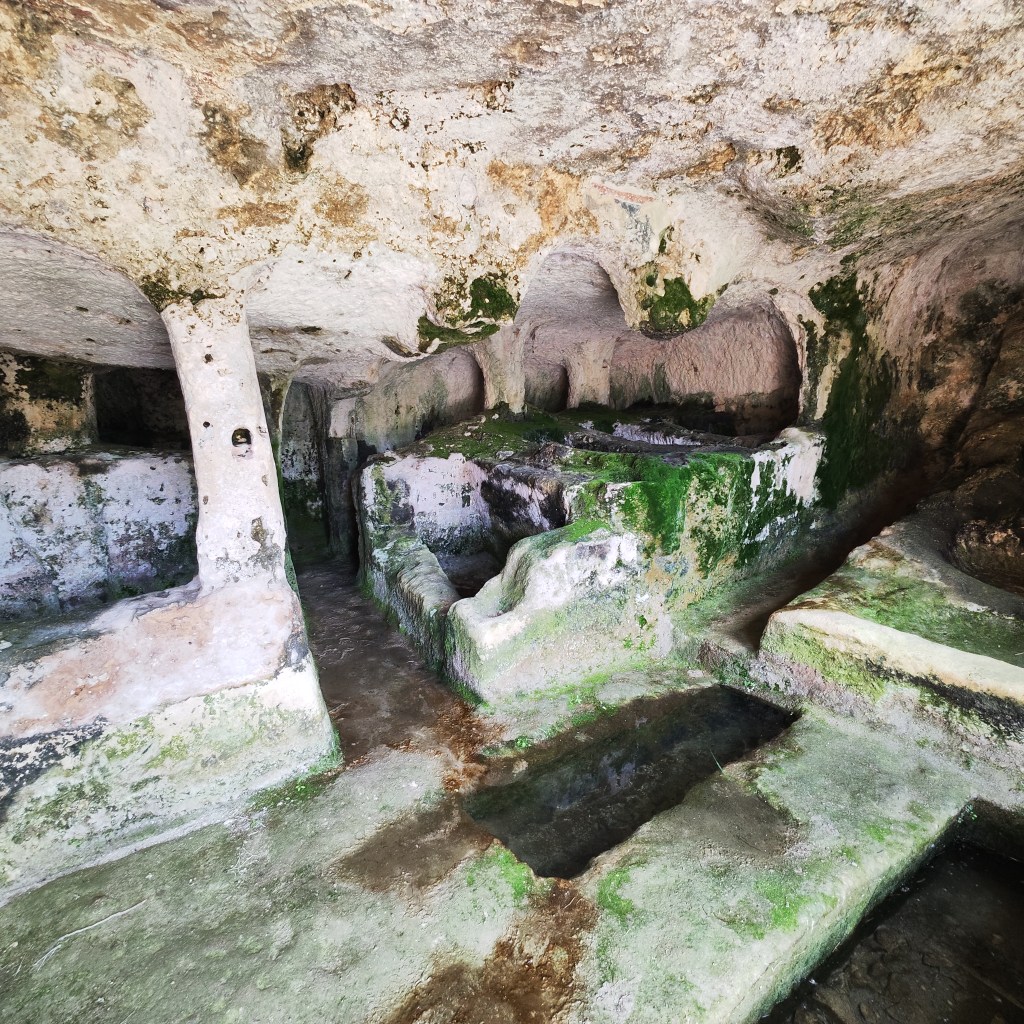
It all begins with a birthday present, many years before I knew what an arcosolium was or who the Normans in Sicily were. I was fifteen, living in Palermo, and someone gave me a camera. I started by photographing whatever was around me: landscapes, insects, flowers. A few years later I began developing and printing my own photographs in the darkroom, and in the meantime diving had come into my life too — and with it, naturally, underwater photography.
Palermo remained home until I was twenty-four. Then work took me to Naples, where I also bought a VHS camcorder — an enormous contraption, the kind that makes you smile just to remember it.
It was in Naples that archaeology entered my life, almost by chance. The discovery of a few amphorae, my visits to the underwater archaeological park of Baiae, and from there I began devouring books on history and archaeology, one after another. But the real spark, the one that turned a curiosity into a project, was my first visit to Cumae. That was where I understood that reading about these places was no longer enough for me: I wanted to tell their stories.
Back in Sicily, I settled for a while in Syracuse, where, thanks to my friendship with a specialised archaeologist, I began exploring catacombs and rock-cut sites. And finally, for some years now, I have been living in Ragusa Ibla. Exploring the Iblean plateau, that passion grew stronger until it became a real project: to reveal, through documentaries, the fascination of forgotten places and of a historical period we very often know only by halves — where the line between established fact and working hypothesis runs thin, and is worth respecting rather than ignoring. A period, and a cultural koine, that does not stop at Sicily’s borders: the Byzantine, Norman and medieval world crossed the whole of Southern Italy, and Pietre Vive means to follow it wherever it leads, not where an administrative region happens to end.
Pietre Vive is born from this thirty-year journey of cameras, dives, books and walks among ruins. Today it is still a project in its early days: the first documentary, on Pentedattilo — in Calabria, and not by chance the first step outside Sicily — is online; the one on the Grotta dei Santi (Cave of the Saints) at Licodia Eubea, on the Iblean plateau, is in production; others — on Castelluccio di Noto, on the Iblean plateau, on Argimusco — are still on the table, in the research stage. The Iblean plateau remains the heart of my work, the land I know step by step and love to tell first. But the ambition is broader: to follow the same historical thread — Byzantine, Norman, medieval — wherever in Southern Italy it takes me, one stone at a time.
I don’t hide this early stage; on the contrary, I think it is worth recounting, because a historical-archaeological documentary never comes out of nowhere. It comes from months of cross-checked sources, of discarded paths, of doubts that sometimes remain open even after publication.
This blog will be the place where I tell that behind-the-scenes work: the sources on which I build each documentary, the criteria by which I distinguish an established fact from a hypothesis, and a hypothesis from a handed-down legend, the second thoughts, the discoveries that change a script halfway through production.
If you already know me from my photography page on Facebook, this is the same camera as always, only pointed at a different subject: no longer just landscapes, insects and seabeds, but the stones of a historical period that, in Southern Italy, we still know far too little about. And here is where I ask you a favour: the YouTube channel is where the documentaries truly take shape — images, 3D reconstructions, narration — but it is still in its early days. If the subject intrigues you, the documentary on Pentedattilo is already online, and the one on the Grotta dei Santi will arrive soon. Subscribing to the channel is the simplest way not to miss the next releases, and for me, at this stage, it means a great deal.
Welcome to the plateau. The journey has only just begun.
Pietre Vive is a historical-archaeological documentation project dedicated to Byzantine, Norman and medieval Southern Italy, with particular roots in the Iblean plateau. The first documentary, on Pentedattilo, is available on the YouTube channel.


Rispondi